The Pritzker Legal Research Center recently subscribed to two additional resources from ProQuest: Legislative Insight and Supreme Court Insight. Both are accessible directly via the embedded links, as well as through the law library’s A-Z list of databases.
Legislative Insight provides compiled legislative histories, including bill versions, Congressional Record excerpts, and committee reports and hearing transcripts, for major federal legislation enacted between 1789-1928, as well as select laws from 1929-1965. Content is organized by number of Congress, is searchable, and is available for PDF download. When used in conjunction with ProQuest Congressional, Legislative Insight will be a tremendously useful resource for discerning legislative intent.
Careful, man, there's a beverage here.
Supreme Court Insight offers case histories, including briefs, dockets, joint appendixes, and transcripts of oral arguments, for argued cases from 1933-2017, as well as for certiorari denied cases from 1975-2018. PDF content is accessible via keyword search, case docket number, or U.S. Reports citation. This resource will supplement content available through Gale’s The Making of Modern Law: U.S. Supreme Court Records and Briefs, 1832-1978.
We hope you find these new resources to be useful and encourage you to reach out to our Reference Department with any questions!
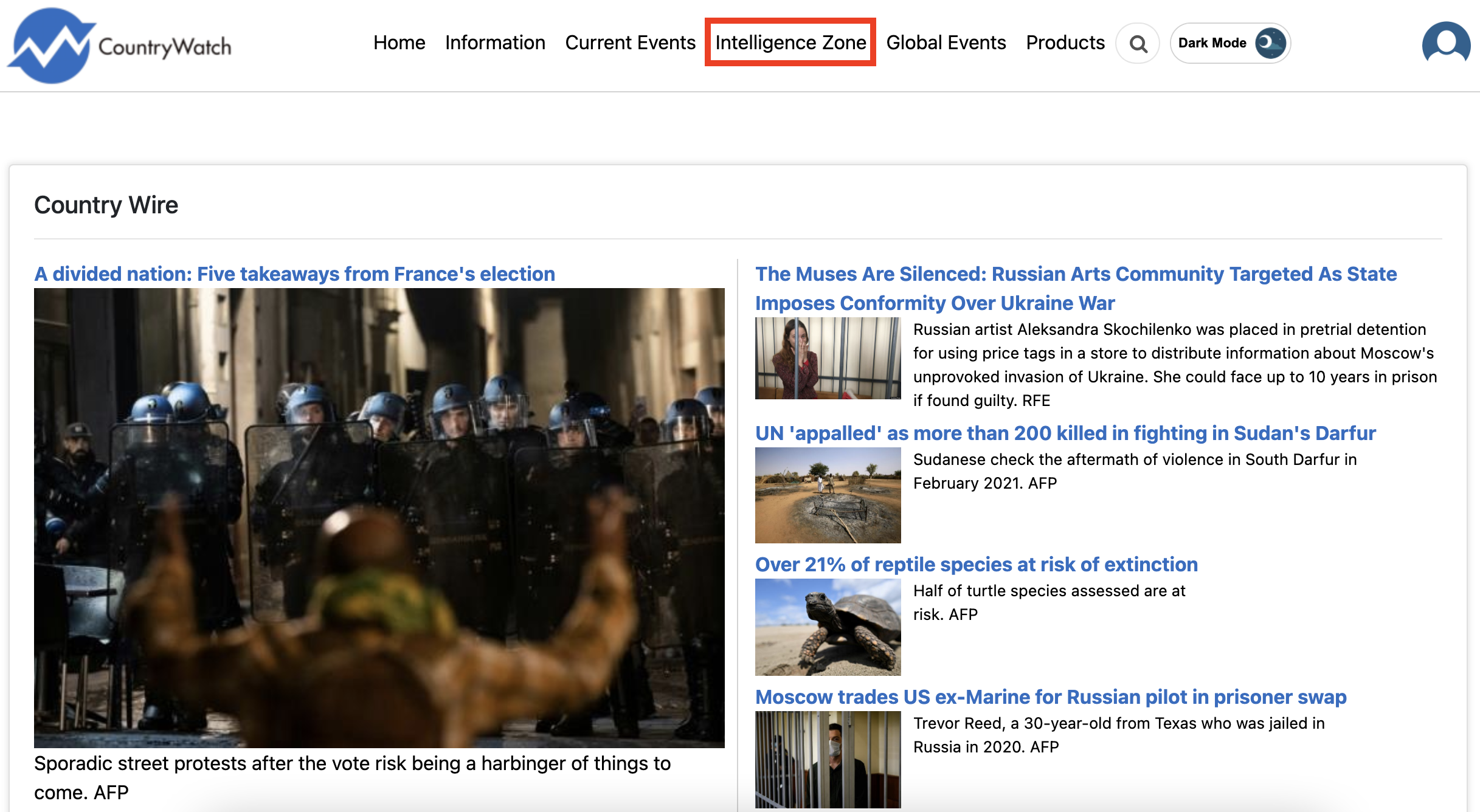
The law library recently subscribed to CountryWatch, which provides up-to-date political, economic, and business information and news on countries around the world.
The key features highlighted below are located under the “Intelligence Zone” tab on the website.
Country Reviews provides detailed reports for each of the 192 countries covered in this database. These reports, which are generally updated and published once a year, provide political, economic, and social overviews for each country, as well as information about investments and the environment. The reports are quite extensive (as an example, France’s Country Review report spans 580 pages) and can be downloaded in PDF.
Country Wire collects news coverage from ten international news organizations. News content can be filtered by country and date.
The website also has an Elections Central section, containing election information from around the world.
Check out this database next time you are working on a project that involves in-depth country research!
Note: If you encounter a login prompt or experience problems accessing content at any time while using this database, select the link located below the login form that says, “Log in via my IP Address.” Access is available both on-campus and off-campus.
The Pritzker Legal Research Center of Northwestern Pritzker School of Law invites service-oriented library science graduate students to apply for the part-time temporary position of Law Library Reference Intern for Summer 2022.
Responsibilities and Opportunities. The intern will provide research, reference and instructional support during the law school’s summer term. The intern will have the opportunity to assist and interact with the law school’s outstanding faculty and student population and will have access to the library’s exceptional print and electronic collection. The library will provide training and opportunities for interaction with librarians, in addition to opportunities to work on special projects and other ventures consistent with the interests of the intern and the needs of the library.
Qualifications. Candidates for the Pritzker Legal Research Center Reference Internship must be enrolled in or graduated from an ALA-accredited library science program, and must have a strong service orientation, an ability to interact positively with diverse library users, and an ability to work independently and efficiently. Course work or experience in reference and legal research methods is strongly preferred. A J.D. or significant legal training is highly desirable, and such qualifications may substitute for reference course work or experience.
Compensation: $20 per hour. The Pritzker Legal Research Center Reference Internship is a temporary part-time position.
To Apply: Review of applications for the Reference Internship will begin immediately and continue until the positions are filled. Candidates should email a letter of application and current resume to:
Northwestern University Libraries has created a Chrome extension that provides a shortcut to searching library collections via NUsearch, Google Scholar or other libraries via Worldcat. Enter your search in the shortcut search bar or you can highlight terms in the text you are reading an right click to access the Library Search Assistant.
We invite you to join us for the latest in the Pritzker Legal Research Center’s Faculty Book Release Discussion series, featuring Professor Paul Gowder. Paul will discuss his latest book, The Rule of Law in the United States: An Unfinished Project of Black Liberation, which is available, free of charge, via Bloomsbury Open Access. The event will be held on Monday, February 7, from 4:00-5:00 p.m., in RB175, and will also be viewable via Zoom (link to be distributed via email to Northwestern Law faculty, staff and students). Grab-and-go snacks and refreshments will be provided at the conclusion of the event. We hope to see you there!
The Pritzker Legal Research Center is looking for Pritzker Library Fellows for Spring Semester 2022. Pritzker Library Fellows serve a 3-month appointment, at $850/month, working 10-15 hours per week on short-term faculty research projects and sourcing/citing for Law Library Journal.
Preferred Qualifications: 2L or 3L status, journal experience, RA experience, judicial clerkship, and/or Advanced Legal Research. If interested, please email copy of résumé and law school transcript to Tom Gaylord, Faculty Services & Scholarly Communications Librarian at tom.gaylord@law.northwestern.edu. Applications will be reviewed on a rolling basis until the positions are filled.
During reading periods and final examinations, access to the library is generally restricted so that Northwestern law students can study and take exams. During this time, the only students who are admitted are Northwestern law students. Students from other universities or Northwestern students outside the law program will not be admitted. Lawyers requiring the research materials may be admitted as under the Usual Access Policy, but are expected to maintain silence for the benefit of students.
The library circulation desk will close early on Wednesday, November 24 at 5:00 pm and be closed on Thursday and Friday, November 25 and 26 for the Thanksgiving Holiday. We will resume normal hours on Saturday, November 27 at 10:00 am. See full schedule of hours.
Northwestern law students, faculty, and staff will continue to have access to the library after the circulation desk closes via their Wildcard. Please see the After Hours Policy for additional details.
Ordinarily, we take to this space to tell you about sources for your research. This month, we are highlighting a resource to help you perform that research. Research Methods: Primary Sources is designed to help those who are researching in the social sciences and humanities (especially history) work with primary sources. Research Methods: Primary Sources lets you teach yourself how to do scholarly work with primary sources. This could be helpful if you wanted to research legal history for your own writing. It might also be helpful if you are working as a Research Assistant to a professor who does historical research.
Recall that primary sources are documents or artifacts that provide evidence or firsthand testimony of events that happened in the past. Secondary sources are things that are written about primary sources. A letter from Franklin Delano Roosevelt to Eleanor Roosevelt is a primary source. A book written by an author about the Roosevelts’ marriage is a secondary source. Research Methods: Primary Sources does help you find primary sources, but it also teaches you how to evaluate them for credibility and bias. It teaches you the importance of what primary sources did and did not survive. A fashion historian would not say that all English women in the 16th century wore those big, frilly collars just because we find paintings of Queen Elizabeth I wearing them.
But you have to admit she looks amazing.
The Learning Tools are guides, essays, and interviews with scholars. You can read about best practices for researching marginalized groups and get some advice on working with spreadsheets, something that anyone who has ever found herself in over her head in a poorly organized spreadsheet can appreciate. Just me?
The Case Studies let you take a peek at how scholars have dealt with primary sources around different source types (ex. photographs), themes (ex. advertising), and data sets (ex. ships’ logs).
If you want to perform primary source research according to best practices, Research Methods: Primary Sources can take you from fumbling ex-history major to confident researcher who knows the sources, where to find them, and how to use them.
Give it a look and, as always, please contact the librarians if you have any questions or need assistance.
The Pritzker Legal Research Center at Northwestern Pritzker School of Law holds a significant rare book collection specializing in Roman, canon, and customary law. Its more than 8,000 volumes include several incunabula as well as first editions of legal classics. On paper, it’s a point of pride, but in reality, it’s a marvel.
Wandering through the rare book storage room, it’s easy to continually find new and surprising gems. And a gem is exactly what I found one day a couple years ago: a folio book covered in an ugly, modern-day library binding, its only captivating external feature the title stamped in gold capital letters: “GOD’S REVENGE AGAINST MURTHER.”
The title drew me in, and to my surprise, the book proved to be as intriguing as its cover was dull. It contained thirty stories that (allegedly) originated from all over continental Europe; they conveyed the (also allegedly) true tales of dastardly murders and the ways in which divine providence ensured the delivery of justice. If the stories themselves weren’t dramatic enough, each one was preceded by an engraved illustration that depicted the tales in small, unintentionally amusing vignettes. I set this book aside as inspiration for a future exhibit, and this year, my colleague, Tyne Lowe, and I brought it to life.
The illustration from History X.
An Inquisition for Blood: Tales of Murder and Justice in John Reynolds’ The Triumphs of God’s Revenge launched in September 2021 as an online exhibit with a small physical teaser installed in our library. Under ordinary circumstances, the PLRC presents its exhibits in our third-floor gallery, and we originally dreamed of taking full advantage of this space. We discussed perhaps installing floor-to-ceiling panels of the book’s illustrations across the library’s walls and potentially displaying related materials from the collection. However, as the COVID-19 pandemic limited our access to the building, our plans had to change. Designing an immersive digital exhibit soon became our new goal.
While working from home, Tyne (acting as curator) and I met weekly via Zoom to plan and build the exhibit. We aimed to summarize each of the stories (no small task when the book in question is over 500 pages long), contextualize the book in early modern English history, and highlight the aspects that we thought would be most relevant to a community of law students and faculty. We split up the task of reading the book itself, which was a challenge during the quarantine; because we were unable to take home or fully digitize our copy of The Triumphs, we found a digital surrogate (via Internet Archive) to use instead. (Although this copy is an older edition than our library’s copy, Tyne compared many pages of text and determined that they were overwhelmingly similar.)
As we worked our way through The Triumphs and discovered relevant secondary sources, we gleaned countless details about crime, religion, gender dynamics, torture, and capital punishment that were completely ordinary in the author’s time but seemed quite shocking to us today. We enjoyed analyzing the copperplate engravings that we saw throughout the book, noting the narrative details that the illustrations chose to highlight (or ignore) while introducing us to the stories. Our meetings ran over their time allotments as we were fascinated by many more elements of The Triumphs than we could possibly fit into the exhibit itself.
On Thursday, October 28th, Tyne and I will be leading a virtual Zoom tour of the digital exhibit, offering behind-the-scenes details about the process of its development and sharing some aspects of The Triumphs that made it such a fascinating study. For more information, please send me an email at Brittany.Adams@law.northwestern.edu, and to explore the exhibit, please visit sites.northwestern.edu/murther.