U.S. News & Faculty Scholarship Metrics

Back in 2019, U.S. News & World Report announced an intention to add a faculty scholarship metric to their law school ranking mechanism. There were proponents and opponents, and many questions about how the sausage would be made, including, but not limited to, which source(s) of data to use, how to adjust for interdisciplinary work (or for faculty who author books (for which we have fewer sources of citation analytics)), how to adjust for gaming the system by self-citation to oneself or one’s colleagues (the former is often tracked, the latter, less so), correcting for differences among more-cited and less-cited topical areas and, perhaps most importantly, how to adjust for traditionally marginalized authors, namely non-white, non-male members of the academy.

Last week, it became public knowledge through this Bloomberg Law article that U.S. News had dropped its plans, though no rationale was given (the Bloomberg Law article was corrected following its initial publication, suggesting that the authors themselves did not know of U.S. News‘s decision to pull back until the publication of their article forced U.S. News to reach out to Bloomberg to correct the record; later paragraphs in the article read as though the scholarship rankings are still forthcoming; the article was posted at 3:00 AM on August 19, and the disclaimer at the end reads: “(The first paragraph of Aug. 19 story was updated to reflect that U.S. News was only considering a new ranking. Second paragraph was added to indicate that U.S. News decided not to pursue this new ranking.)”)

So where does this leave us? Personally, I think USNWR was really hoping to go with a “one source fits all” approach, and HeinOnline is the best for pure law review citations, but relatively light on interdisciplinary and no real help at all with books. And that’s the problem in legal publishing: we have no “best” source for citation analytics. Before Google Scholar and HeinOnline started tracking citations, the legal academy mostly focused on SSRN data; in fact, some were so focused on SSRN that there were faculty who were opposed to their schools hosting institutional repositories out of fear that it would pull their SSRN stats down (this has been debunked). Today, Google Scholar has the best universe of data, in terms of coverage, thanks to being publisher-agnostic and the strength of their book-scanning project; the problem, however, is that it is a *very* messy universe, with many cites counted numerous times (and other errors, like picking up index and table of contents entries as “publications”). There would need to be significant data cleanup and disambiguation and Google has no real incentive (yet?) to do that.

Scopus and Web of Science would be better than Hein on interdisciplinary data and they cover a small universe of books (nowhere near Google, though), but their legal holdings are slight: a few hundred law reviews and about 50% of them are commercially-published European journals. They both started as STEM and peer-reviewed-only, which is why US law reviews are not well-covered, but they’ve relented a little on that; they’d be more viable options if they relented all the way.

And while SSRN’s intention is to be a source for working papers, many authors use it as a personal repository; the rub is that SSRN will not post a final published version unless the author can show that she, and not the publisher, has copyright. If the publisher retains copyright, the final version cannot be posted.

What all of this boils down to is that with no one source, we should be using all of them, whether analyzing scholarly impact, compiling metrics for hiring and promotion decisions, or for claiming and enhancing (where possible) author profiles. Some Northwestern Law faculty have created their own Google Scholar author profiles and that does help separate some of the bad data out (if you have not, you can start here and click on “My Profile” (you’ll need to establish a Google account if you don’t have one)); everyone who has published an article that is in HeinOnline has an author profile there, (whether they’ve claimed it or not). And yes, we should post whatever we want to SSRN, subject to the above caveat.

Thus, while the jury is still out on the value of quantitative scholarly metrics, the fact remains that they are here to stay, and with that in mind, we should strive to make sure our work is properly recognized and visible.

Posted in Scholarship

Student Library Assistant Positions Available for Fall

The Pritzker Legal Research Center is looking for reliable law students to work at the library circulation desk this fall. Duties include the following:

  • Check out and check in books, journals, reserve books and other library materials
  • Answer basic informational, directional and library policy questions, help patrons locate materials in the stacks, provide basic printer and copy machine assistance
  • Help troubleshoot public computers according to directions
  • Record and tally usage statistics
  • Search the stacks for books reported missing
  • Assist with opening and closing procedures

Interested students should send the completed application form and resume to James Driscoll, Circulation Services Manager.

Posted in Employment, Position Available

Resource Spotlight: Yearbook of International Organizations Online

With the 2020 Tokyo Olympics in full swing, maybe you were wondering why Russian athletes are competing as Russian Olympic Committee and wanted to find out more about, say, the World Anti-Doping Agency (WADA) or the International Olympic Committee (IOC). Well, with the Yearbook of International Organizations Online, you can do just that!

The database has multiple search capabilities, including by the name or acronym of the organization itself; by geography; by type or subject matter of the organization, etc; even searching by location of past and future meetings is an option! There are also indexes that allow users to browse by geography and subject matter.

Looking up WADA in the Yearbook gives you information such as its founding date, history, and aims; and a timeline of events (including events preceding the founding of the organization, if appropriate; for example, in WADA’s case, while the organization was founded in 2000, the timeline includes the February 2, 1999 World Conference on Doping in Sport, which helped bring about the founding of WADA). Other information includes the organization’s structure, the number of staff, its official language(s), locations of regional offices, relationships with other organizations, and more. A subject index on the organization page allows users to easily find other organizations involved in the same or similar topics. A list of regular publications, if any, issued by the organization is also included. Finally, both inter-governmental organizations (IGOs) and non-governmental organizations (NGOs) are included.

Screenshot of top of page for WADA entry at Yearbook of International Organizations Online.

So, if your research requires looking into IGOs and NGOs occupying a certain space in international law, Yearbook of International Organizations Online is a good place to start and to familiarize yourself with the major players on the world stage.

Posted in Library Resources, Resource Spotlight

Resource Spotlight: Westlaw UK

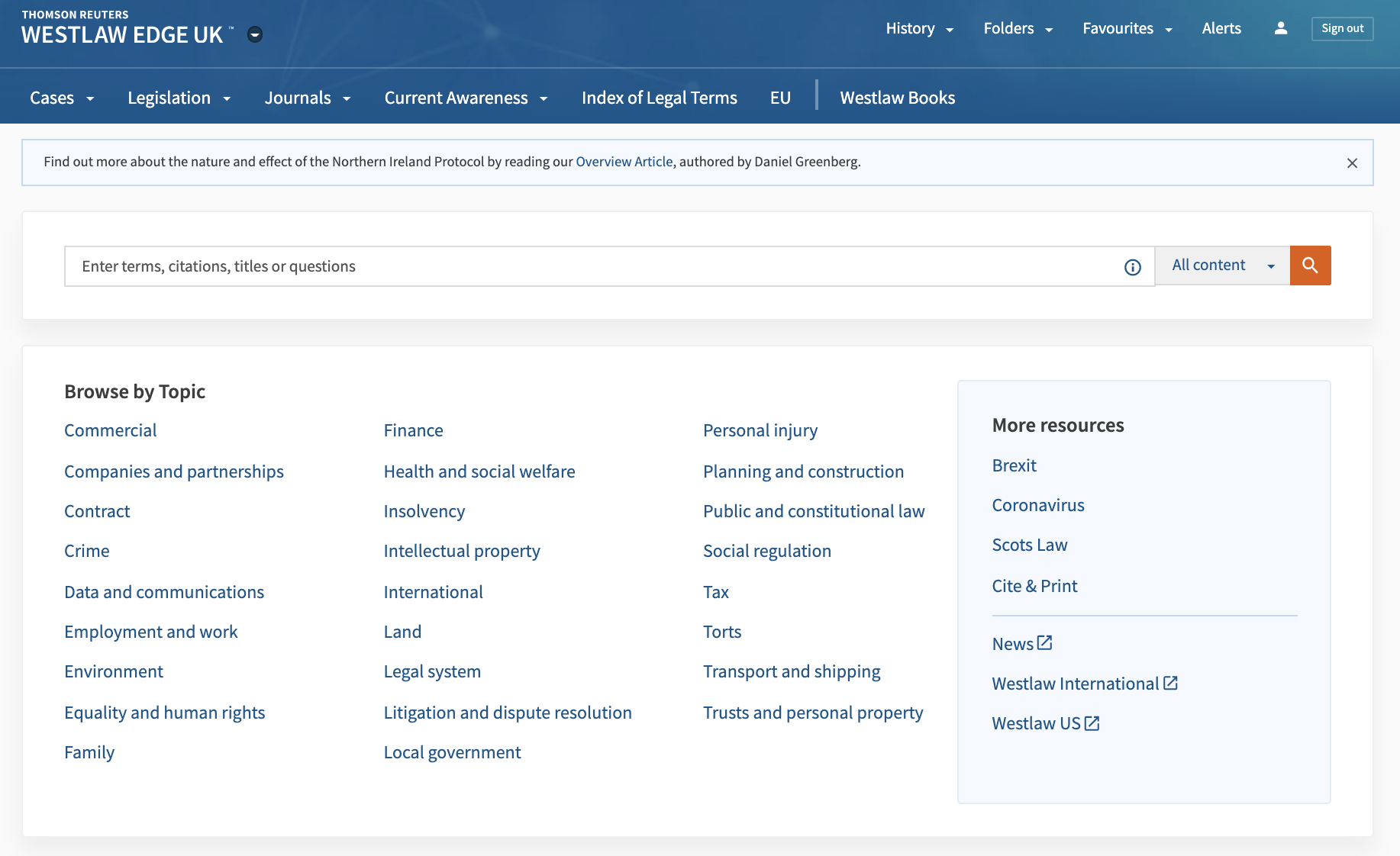
Students and faculty now have access to Westlaw UK, which is a full-text searchable database for UK case law and legislation. To log on to this database, use your regular Westlaw username and password on uk.westlaw.com.

Westlaw UK homepage

You can easily retrieve cases by typing in the citation (if known) or by conducting a full-text search. Additionally, you can also search for cases using various fields, including subject, parties, or judge.

When you retrieve a case, the default view will be a case digest that provides a summary of the case, basic information about the case, and its appellate history, though you can easily toggle to the full-text judgment.

Case Digest

Note: If you are looking at an older case that does not contain an option to access the judgment because it is only available in a law report (which is outside the scope of this subscription), you can use another database called ICLR.3 to retrieve judgments published in law reports.

Using Case Analytics, you can view a precedent map to see cited cases and citing cases as well as treatment information to see how other cases have treated this case.

Precedent Map

Similar to KeyCite, status icons are assigned to cases and legislation to help you quickly determine whether they are still good law or in force.

For legislation, Primary References will identify cases that cite to a provision (i.e., section of an act), while Commentary References will contain links to books and secondary materials that discuss the provision.

Legislation - Primary References and Commentary References

The Statutory Annotations feature allows you to obtain additional context about the legislation, such as relevant excerpts from Explanatory Notes and notes on its passage through Parliament.

Statutory Annotations

In addition to cases and legislation, you can also access EU legal materials and journals or can set current awareness alerts on Westlaw UK. If you are unsure about how a term is defined, use the Index of Legal Terms to search for the term across three legal dictionaries (Jowitt’s Dictionary of English Law, Stroud’s Judicial Dictionary of Words and Phrases, and Osborn’s Concise Law Dictionary).

Many of the features, functions, and search options available on Westlaw UK are similar to what you may already be accustomed to using on Westlaw (U.S.), but you will also encounter new features that we can hope will become available in our U.S. version of Westlaw in the near future!

Tagged with:
Posted in Resource Spotlight

Resource Spotlight: JSTOR Text Analyzer

JSTOR Labs recently announced a new way to search called Text Analyzer (https://www.jstor.org/analyze/). You can upload a document such as a draft paper or another article that you found on JSTOR and the Text Analyzer generates a list of research articles and subject terms to help you find new sources. We have seen similar technology in brief checking tools offered by Westlaw and Lexis, but this is the first tool we’ve seen that applies this kind of AI in a scholarly setting.

How does it work? After you upload a document, the tool analyzes the text for key topics and phrases. It will identify certain keywords as “prioritized terms” and then look for similar content in JSTOR. The Text Analyzer allows you to edit the list of “prioritized terms” by adding or removing words or phrases or by adjusting their importance.

While I imagine that MS Word or PDF files would be the most common types of documents uploaded, the Text Analyzer accepts the following types of files: csv, doc, docx, gif, htm, html, jpg, jpeg, json, pdf, png, pptx, rtf, tif (tiff), txt, xlsx.

JSTOR offers a few other tips and suggestions for how the tool can be useful:

  • If you access Text Analyzer using your phone, a camera icon will appear — use it to take a picture of any page of text and search with that.
  • To run Text Analyzer on the text of a webpage — whether it’s a Google Doc or a NY Times article — drag and drop or paste the URL into the search box.
  • Get creative with the kinds of documents you search with: try your class syllabus, the webpage of a news article, or the first paragraph or outline of a paper you’re writing.
  • Try searching with non-English-language content if you have it — Text Analyzer can help you find you find English-language content about the same topics in JSTOR.

Note that the JSTOR Text Analyzer tool is still in beta, but it shows potential as an additional tool in your research toolbox.

Posted in Resource Spotlight

Resource Spotlight: Almanac of the Federal Judiciary

The Almanac of the Federal Judiciary is a must-use resource for background information on federal judges. Helpful to both litigators and judicial clerkship seekers alike, it provides a wealth of information not included in free public resources, such as the Federal Judicial Center’s Biographical Directory of Article III Federal Judges, 1789-present.

In addition to the Supreme Court of the United States, the United States Courts of Appeals, the United States District Courts and the United States Bankruptcy Courts, the Almanac also covers the judges of the Court of Appeals for the Armed Forces, the Court of Appeals for Veterans Claims, the Court of Federal Claims, the Court of International Trade, and the United States Tax Court.

A typical district/circuit judge bio in the Almanac includes the following:

  • Contact info
  • Office staff
  • Biographical info
  • Publications
  • Noteworthy rulings
  • Lawyer evaluations
  • Civil & criminal practices/procedures
  • Senate nomination questionnaire
  • Annual financial disclosure statements

For both litigators and clerkship seekers, the lawyer evaluations are especially important, and the civil & criminal practices/procedures section (for district court judges) are also a boon to litigators.

Profiles of Supreme Court Justices go into greater detail, including such categories as “Media Coverage;” “Quick Sketch;” “Verbatim” (a quote or quotes from the Justice); “If You Need Her Vote” (explaining to Supreme Court advocates how to tailor arguments towards a particular Justice); “At Oral Argument” (highlight the Justice’s tendencies during oral arguments); “If You Meet Him” (topics that appeal to the Justice when engaged in conversation); “Just One Case” (a suggestion of which of a Justice’s opinions to read to get the overall impression of their judicial philosophy); and “Friends and Adversaries” (highlighting which other Justices are most likely and least likely to be aligned in voting, based on the most recent term’s statistics).

Two other unique aspects of the Almanac contribute to its must-see status. First, it is not limited to current information; it retains archived profiles of those judges who have retired or passed away (judges that have taken senior status are still included as active profiles). Second, it contains profiles for U.S. Magistrate Judges, for whom there is less publicly-available content available (including their omission from the FJC biographical database).

All in all, the Almanac is a total package for students researching federal judges for potential clerkships (both in terms of deciding to whom to apply and as essential in preparing for the interview process) and for litigators (including clinic students) who need to know how the judge to which their case is assigned ticks.

Tagged with:
Posted in Employment, Library Resources, Resource Spotlight

Resource Spotlight: Oxford Bibliographies

If you need to conduct a literature review or would like to identify reputable secondary and primary sources on a topic or concept, you may be able to save a ton of time by consulting Oxford Bibliographies.

Oxford Bibliographies provides access to annotated bibliographies that are written and reviewed by academic experts. Each bibliography includes a brief overview of the topic or concept along with citations to relevant primary and secondary sources. The sources included on the bibliographies are selective to ensure that they contain the best available scholarship.

You can access Oxford Bibliographies: International Law via our law library’s A-Z database list. Additionally, you also have access to Oxford Bibliographies for numerous additional subject areas ranging from criminology to public health to African studies through Northwestern University’s A-Z database list.

Let’s take a look at Oxford Bibliographies: International Law. You can browse entries alphabetically or conduct keyword searches in the upper right corner of the screen. If you conduct a keyword search, you can restrict that search to a particular subject area (using the advanced search feature), or you can search across all subject areas included within Oxford Bibliographies.

For example, if you are researching cyber warfare, this bibliography on cyber warfare can be a useful starting point for your research.

The bibliography identifies literature providing a general overview about cyber warfare as well as literature discussing the development of the law of cyber warfare and state responsibility in cyberspace. Each source listed in the bibliography contains a citation and brief summary. You can retrieve the books and materials in NUsearch or by using the “Find this resource” feature accompanying each citation.

Consider checking for an annotated bibliography on Oxford Bibliographies whenever you need to identify relevant secondary and primary sources on a topic or concept!

Posted in Resource Spotlight

A Brief History of NULS Student Newsletters, Part 3: Trash or Treasure? Perception of The Pleader and HOOPS by the Campus at Large

Unfortunately, little documentation survives to offer a full understanding of how The Pleader and HOOPS were perceived by their communities during the time of their publication. The newsletters themselves printed letters that praised and disparaged the newsletters’ content, but the newsletters were rarely mentioned in other primary sources written about and for Northwestern Law. Although editors of The Pleader and HOOPS frequently mentioned deans of the Law School and other administration officials, the degree to which the administration discussed the newsletters in official and unofficial channels is unclear. One source that did mention the newsletters is Northwestern Law’s The Reporter, a magazine that chronicled events and alumni news. The Pritzker Legal Research Center has a rich collection of digitized Reporter issues, and searching this digital collection revealed that The Reporter acknowledged the existence of The Pleader twice around the time of the latter’s foundation. First, the Summer 1978 issue of The Reporter mentioned The Pleader in passing in the essay “A Report on the Year 1977-78, Northwestern University School of Law” by Dean David S. Ruder: “A new student newspaper, The Pleader, has added spice, wit, criticism, and current events to the Law School scene.” Later, the Fall 1978 issue of The Reporter dedicated half a page to The Pleader in an essay about the newsletter’s first year of publication (see illustration). Describing The Pleader’s role as “an open forum for the Law School community [that] strives to be responsive to all areas of the School”, the author plainly recounted the historical formation of the newsletter, naming the founding editors and listing some of the contents of each issue. Besides describing The Pleader as adding “spice”, there is little characterization of the critical role that The Pleader undertook. Throughout the 1980s and 1990s, The Reporter made no mention of HOOPS at all. Further research is required to see if The Pleader or HOOPS were described in non-digitized Northwestern publications. 

Despite this apparent dearth in written acknowledgement, both The Pleader and HOOPS were keen to report any opinions expressed by Law School officials about the newsletters, which usually took the form of verbal statements. For example, a 1987 issue of HOOPS ran a cover story describing how a senior faculty member was overheard referring to HOOPS as “trash”. The outrage in the article was palpable: “To disparage this forum is to disparage the many who have sacrificed their time and effort to contribute articles, features, and information; to cheapen their contribution is to demean a valuable asset of law school life.” The responses in the following issue raised questions about the validity of both the faculty member’s remark and HOOPS’s outraged response. In a letter to the editors, one student criticized HOOPS for printing the equivalent of gossip by choosing not to confirm the quote with the faculty member. “It all leads to the conclusion that HOOPS editors are more interested in bashing [the faculty member] than promoting ‘constructive criticism’ or dialogue and providing reliable information,” the student wrote. He also questioned HOOPS’s own character, which seemed to embrace bawdy humor to the point of self-identifying as a “trashy” publication:  

“These are the same editors who dish out plenty of ‘disparaging’ remarks in the Bar Review. And this is, after all, the same publication that prints [the f-word] in a headline and runs cut-outs of NULS faculty in embarrassing costumes and poses. The Sun-Times has been called trash for a lot less. It’s all a lot of fun, and I always enjoy reading HOOPS. It is definitely a ‘valuable asset of law school life,’ as HOOPS editors put it. But sometimes, in some parts, it’s just trash. So what? Are those parts meant to be anything else?” 

On the same page, a wry letter from a professor – indeed, the same professor who wrote the infamous “300-500%” letter back in 1978 — denounced the faculty member’s comment while artfully offering his own attack. “Since I am only objecting to [the faculty member’s] characterization, and not offering an affirmative proposal of my own, I will refrain from attempting to characterize your publication in a mere word. (Actually, the word ‘mere’ itself might be good for starters.) I think you should apply your ingenuity to this task and come up with a self-characterization. You might begin by investigating the ecological significance of the felling of forests to provide thin products upon which symbols of dubious significance are imprinted.” A careful reader might notice that this professor’s name is included in HOOPS’s list of staff members on the issue’s second page, his involvement offering a tacit endorsement to offset the biting tone of his letter. 

Did more readers think of HOOPS as trash or as a valuable asset to the Law School community? As the student letter suggests, there may have been some validity to both stances. Even to a contemporary reader, it is clear that some portions of HOOPS – and The Pleader – included gossip, bawdy humor, and cheap jokes about professors with no basis in legitimate critique. A 1986 issue of HOOPS (see illustration) included a collage of faculty member faces pasted onto models in bikinis, an illustration that might be considered more juvenile than substantive in its content. The Pleader also took its share of jabs at faculty members, such as in heavily annotated caricatures (see illustration). However, the comedy in the newsletters was sometimes used to explore substantive issues, similar to the contemporary parody publication The Onion; a 1987 issue of HOOPS included one such satirical page that discussed censorship (see illustration). Moreover, even at its silliest, the indulgence in jokes for their own sake cannot fully offset the role of these student newsletters in providing a unique, widely-read forum in which students offer critique to the institution receiving their tuition. The Pleader and HOOPS provided a unique means by which to engage in discussions and share law school experiences, cultivating a kind of community in its readership that may not have existed before or since.

Posted in Archives, Law School History, Library Resources, Uncategorized

Resource Spotlight: African American History Month Resources from the National Archives

In celebration of Black History Month, the National Archives has curated a collection of African American History Month Resources. Needless to say, our National Archives contain a vast collection of primary and secondary materials related to the Black experience in America; in fact, the largest such collection our country has to offer, spanning time from the dark dawn of slavery in the colonies to today’s continuing civil rights struggle.

Due to the pandemic, the National Archive and Records Administration aka NARA aka the National Archives, is not open to the public. However, their research guides make exploring online resources a breeze, whether you’re interested in various topics or a time period in the chronological development of the Black experience.  There’s three collections I would like to highlight: The American Image: Portrait of Black Chicago, The Modern Civil Rights Movement, and the Center for Black Music Research.

The American Image: Portrait of Black Chicago
John H. White, currently the staff photographer for the Chicago Sun-Times but then a photographer for the Chicago Daily News, took a series of photographs of Chicago’s African American community from mid-1973 to early 1974. He took these photos as part of the Environmental Protection Agency`s (EPA) DOCUMERICA project, and they comprise a candid time capsule view of Black life in Chicago during the early 1970s. [To navigate this collection, use the Intro, Part One, Part Two, Part Three links found under the photographer’s name in the top left corner.]

The Modern Civil Rights Movement
Chicago is the home of the midwestern regional office of the National Archives featuring permanent records created by federal agencies and courts in Illinois, Michigan, Ohio, Indiana, Minnesota, and Wisconsin. Many of these materials have not been digitized and made available online, but this civil rights finding aid details notable civil rights cases from the Great Lakes region and the many primary records, such as court documents and investigative reports from federal agencies, available at the Chicago site.

Center for Black Music Research (CBMR) 
While the National Archives own holdings are extensive, they also index other archival and research collections on aspects of the Black experience, so browsing the National Archives guides will lead you to other niche collections like the Center for Black Music Research at Columbia Community College in Chicago. This Center collects materials on Black music in world culture, including the United States, and features personal scores, recordings, notes, and other ephemera created as part of the artistic process of musical composition. Use their finding aids to discover both interesting and invaluable materials providing a unique and immersive view of the influence of Black musicians on American and world culture.

Lastly the National Archives maintains an impressive Calendar of Events that offers regular programming, including live-streamed lectures featuring distinguished scholars and panelists. Every fourth Thursday there is a free “Lunch and Learn” event; Thursday, Feb. 25 is The Black Family: Representation, Identity, and Diversity, a panel discussing the complexity of the Black family as the foundation of African American life and history. Follow the National Archives on Facebook, Instagram, and Twitter, or sign up for a newsletter to keep up with announcements, newly curated collection reveals, events, and more.

Posted in Library Resources, Resource Spotlight

A Brief History of NULS Student Newsletters, Part 2: The Pleader, HOOPS, and The Role of Critique

Front cover, HOOPS, vol. 12, no. 13, November 24, 1992.

Throughout their publication histories, student-run newsletters The Pleader and HOOPS positioned themselves as politically motivated forces: they offered law students a platform that reversed traditional hierarchies of power in the law school, allowing students to respond to the daily function of the school and offer criticism about authority figures whose decisions affected them. In their editorials, the staff writers took an active role in amplifying controversial statements or actions from the administration, boldly sharing their own critiques and soliciting student responses to these issues, too.  

Many of these writers focused on news specific to the law school, like statements from the dean, but others responded to contentious events that affected the Northwestern community on a whole. In an April 1978 issue of The Pleader, the editors addressed Northwestern’s decision to grant an honorary degree to Israel’s Prime Minister. In response to this event, the editors printed several letters from law students criticizing this decision and released a poll inviting students to submit their opinion on the honorary degree conferral. Printing the results of the poll in the next issue, the editors of The Pleader demonstrated a desire to affect institutional change democratically by collecting and disseminating student response.  

The Letters to the Editor sections gave the larger law student body a context in which to discuss law school issues large and small, serving as an analogue social media platform specific to the Law School. Among many other topics, students frequently shared their opinions on their courses; these letters were required to be signed by their author, but the lack of anonymity did not seem to deter students from strongly wording their critiques. A contemporary reader may wonder if these students would be as willing to speak out in a face-to-face classroom setting as they were in The Pleader or HOOPS; like in an online forum or comments section, the removed context of the newsletter may have offered students the freedom to speak more candidly, especially in a newsletter by and for their peers. Despite their student focus, these newsletters were not simply echo chambers for student opinion: as The Pleader gained popularity (and perhaps notoriety) on campus, it also became widely read among faculty and administration members, including those on the receiving end of student criticism. The newsletters allowed such faculty members to respond to criticism that had been printed in previous issues, and dialogue often developed in the Letters to the Editor section from issue to issue. Perhaps because the student-run newsletter prioritized the student voice above any other, students often had the final word in such printed exchanges that involved authority figures like professors.  

For example, a 1978 issue of The Pleader printed a brief letter to the editor from a law student concerned about professors’ grade turnover. Without naming any faculty members, the student is far from shy in her criticism. “What I want to know is this,” she begins. “What are our professors getting paid for if they can never grade our exams within anything approaching a reasonable time?” In the following issue, a law professor submitted a rebuttal to this letter, denouncing the student’s critique and taking the greatest issue with the student’s jab at faculty members’ compensation. “I could be making 300% to 500% more money than I am making here by practicing law, and my colleagues can say the same. Therefore, I would suggest that your tuition be at least quadrupled, so that law professors can earn an income that would be on par with what they could earn on the outside.” 

Student responses to the professor’s rebuttal flooded the following Pleader issue. Nearly 3 pages were dedicated to letters to the editor regarding the professor’s defense of his work, many matching or escalating the biting tone of the previous issues’ letters. “[The professor] suggests that he could quintuple his income in practice,” one student writes. “Perhaps. But I wonder if he would still have time to produce Broadway shows and do leisurely research in areas which interest him.” Another student submitted a clever metaphor that would be legible to anyone who had been following this exchange: “A accepts employment as a garbage collector. He subsequently decides not to empty cans on the north or west side of any street or alley because: (a) it’s a pain in the neck; and (b) he could make more money as a plumber. Logical?” It is easy to imagine such sharp retorts to an authority figure (one who may or may not control these students’ grades) igniting conversation around the law school and even altering the dynamic between students and faculty at the time.

Posted in Archives, Law School History, Library Resources, Uncategorized

Enter your email address to follow this blog and receive notifications of new posts by email.

Join 390 other subscribers